How to calculate crypto position size before entering a trade
Last updated: September 10, 2026
Key Takeaways
- Buy 0.5 BTC at $60,000, and the notional is $30,000.
- On a $5,000 account, risking $50 on one trade means your risk amount is $50.
- Entry at $2,000 with a stop at $1,950 puts the stop distance at $50 per unit.
- A setup that may need 2–3 days in the market deserves a hard look before entry.
Table of Contents

- Who this is for, and who should use a different approach
- What does “position size” mean in crypto?
- How do I calculate crypto position size step by step?
- How do I calculate it when I use leverage or futures?
- What mistakes do people make when sizing crypto trades?
- When should I stop and get help instead of sizing the trade myself?
- What changes when the market is thin, fast, or gapped?
- How do I know the size is sensible before I click buy or sell?
Crypto position size is the amount of capital you commit to one trade. The cleanest way to calculate crypto position size is blunt: decide how much of your account you are willing to lose if the trade fails, then divide that figure by the gap between entry and stop-loss. I am not giving financial advice here, and your own situation may call for a qualified adviser, especially if you trade with leverage, use borrowed money, or face tax and legal rules that differ by country. For a general risk-management overview, see the SEC investor bulletin on margin and the CFTC risk warnings on leveraged products.
Who this is for, and who should use a different approach
This method fits a trader who already knows the account balance, the entry level, and where the idea gets invalidated. It assumes you can read a chart, place a stop-loss order, and estimate fees on an exchange or broker. Simple enough. The sequence matters: define the loss first, size the trade second, and let the market do the rest.
Not ready to name the wrong point? Then don’t size yet. Position sizing depends on the distance to a stop, and a stop only means something if it sits at a price that proves the setup failed. A vague “mental stop” is no stop at all. On most spot and derivatives platforms, that means a real price level, not a feeling.
And no, this is not for anyone trying to gamble the account on one setup. If you are tempted to risk a large chunk of your balance because a coin “looks ready to move,” that is exactly when position sizing matters most. One bad bet can turn into a crater. The calculation is there to keep a single mistake from becoming a large drawdown.
It is not the right tool if you have no stop-loss discipline, if your position will be partly hedged elsewhere, or if the instrument has unusual execution rules such as thin order books, forced auto-deleveraging, or wide funding swings on perpetual futures. In those cases, the math still matters, but the clean formula needs adjustment. Messy inputs. Messy answer.
What does “position size” mean in crypto?

Position size is the number of units you buy or sell, or the dollar value you allocate to a trade. In crypto, that can mean a fraction of BTC or ETH, a dollar amount of USDT worth of a token, or one futures contract depending on the platform. The label changes; the risk it creates is what counts.
The key term is risk per trade: the maximum amount you are willing to lose if the stop-loss is hit. Many traders set this as a fixed percentage of account equity, but that percentage is a personal risk choice, not a universal rule. Different countries, tax treatments, and account types can make a fixed percentage more or less appropriate, so consult a qualified tax or financial professional if the trade affects your broader money plan.
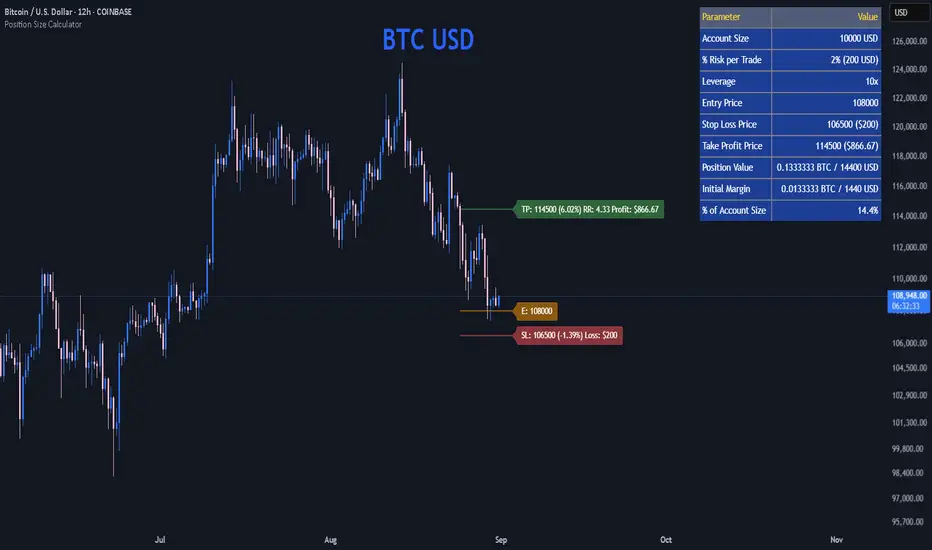
A second term is stop distance, which is the gap between your entry price and your stop-loss price. If you enter at $50,000 and your stop is at $48,500, the stop distance is $1,500 per unit of the asset. Wider stop, smaller size. That’s the trade-off.
A third term is notional value, which is the total dollar value of the trade. Notional matters because fees, slippage, leverage, and liquidation mechanics all scale from it. A 2x leveraged futures position and a spot position may create the same market exposure, but the account mechanics are not the same. Same exposure. Different plumbing.
The formula is straightforward:
Position size = risk amount ÷ stop distance per unit
That gives you the number of units to trade. If you want dollar notional instead, multiply the units by the entry price.
How do I calculate crypto position size step by step?
Work backward from the loss you can accept, then check fees and leverage before the order goes live. That is the process I would use.
- Set your maximum loss for the trade in dollars. Pick the number before you look at profit targets, usually as a small fraction of account equity rather than a vague “safe” amount. Verify that the figure is something you can lose without changing your trading plan. A problem shows up if the amount is large enough that one stop-out would force you to alter later trades.
- Mark the exact entry price and stop-loss price. Use real prices, not ranges. If you plan to enter at $62,400 with a stop at $61,700, the stop distance is $700 per coin. Verify the stop sits at the level that actually invalidates the setup. A problem appears if the stop is placed only because it “feels tight” or because the dollar loss looks smaller.
- Subtract fees and likely slippage from your risk budget. Exchange fees are usually small per trade, but they still matter on frequent trading or larger size. Slippage is the difference between the price you expect and the price you actually get, which can widen on fast-moving or thin markets. Verify whether your platform charges maker or taker fees and whether the order type you use is likely to cross the spread. A problem appears if the calculated loss fits the budget only before fees.
- Divide your risk amount by the stop distance per unit. If your maximum loss is $100 and your stop is $5 below entry, the position size is 20 units. Verify that the result is in the asset units your platform uses. A problem appears if you accidentally divide by the percentage stop instead of the dollar stop per coin.
- Convert units to notional value. Multiply the unit size by the entry price to see the dollar exposure. If you buy 0.5 BTC at $60,000, the notional is $30,000. Verify that this notional fits your margin and leverage rules. A problem appears if the notional is much larger than you expected because you forgot how leveraged products are quoted.
- Check margin and liquidation distance if you use futures or margin trading. Leverage changes how much capital you post, but it does not change the underlying market risk. Verify your liquidation price is well beyond the stop-loss. A problem appears if the exchange can liquidate you before your stop can execute, which can happen when leverage is too high or the market gaps.
- Round down to the platform’s lot size or contract size. Many exchanges only allow certain increments, such as 0.001 BTC or whole contracts. Verify the rounded size still keeps your loss within the original limit. A problem appears if rounding up increases risk beyond your plan.
- Place the order only after rechecking the full loss at the stop price. Multiply the final size by stop distance, then add rough fees. Verify the total matches your pre-set maximum loss. A problem appears if the real loss is meaningfully above your budget, even by a few dollars on a small account.
For example, if your account is $5,000 and you decide one trade may lose $50, your risk amount is $50. If your entry is $2,000 and your stop is $1,950, the stop distance is $50 per unit. The position size is 1 unit. If fees and slippage could add $3, your real risk is closer to $53, so you may need to trim size slightly. Tiny details. Big difference.
How do I calculate it when I use leverage or futures?
You still calculate the same way, but leverage changes margin, not the loss formula. That is the part many people get backward. A 10x leveraged trade can still only be worth the same risk amount as an unleveraged trade if your stop distance and size are set correctly.
With futures, start with the same risk amount and stop distance, then check the contract specification. Some contracts are linear, where profit and loss are settled in the quote currency, and some are inverse, where the coin itself is part of the calculation. Contract size, tick size, and maintenance margin all matter. A 0.01 move can mean very different dollar loss depending on the market and contract type. That math can get slippery fast.
The dangerous mistake is treating leverage as permission to open a larger position because the margin required is smaller. Margin required is not the same as risk. A position that ties up only $200 of margin can still lose far more than that if the market moves through your stop or gaps during fast conditions, so consult the platform’s documentation and consider qualified advice before increasing size.
You also need to check liquidation risk. If your stop sits too close to the liquidation price, the exchange can close the position before your order executes. That is not a rare edge case on volatile assets like BTC, ETH, or thin altcoin contracts during sudden moves. If you cannot clearly keep the stop outside liquidation territory, the trade is poorly structured.
For perpetual futures, funding rates can also affect the cost of holding the trade for more than a few hours. Funding does not change the initial position size, but it changes the economics of staying in the trade. If a setup depends on holding for 2–3 days, that cost deserves attention before entry.
What mistakes do people make when sizing crypto trades?
The biggest mistake is sizing by confidence instead of risk. A strong chart pattern does not justify a larger loss cap. One bad call can punch a hole in the account. The correct alternative is to fix the dollar risk first and let the chart only choose the stop.
Another common error is placing the stop where the loss feels acceptable rather than where the trade thesis fails. That usually means the stop is too tight and gets hit by normal noise. The consequence is churn, not better discipline. The correct alternative is to define invalidation on the chart, then adapt position size to that distance.
A third error is ignoring fees, spread, and slippage. On liquid major pairs this may be minor, but on smaller tokens or during fast moves it can change the realized loss enough to matter. The consequence is that your “1% risk” trade is no longer 1%. The correct alternative is to subtract a cushion before you calculate size.
A fourth error is rounding up to a convenient number of coins or contracts. That looks harmless on a small chart, but the risk jumps in absolute terms. The consequence is unplanned exposure. The correct alternative is to round down and accept the slightly smaller trade.
A fifth error is mixing account size with available cash. If part of the account is already locked in another position or used as collateral elsewhere, your true risk budget is smaller than the headline balance. The consequence is overcommitment. The correct alternative is to size from free equity, not from the number at the top of the screen.
A sixth error is changing the stop after entry because the position is larger than planned. That is not risk management; it is moving the goalposts. The consequence is that one trade can become a loss far beyond the original plan. The correct alternative is to reduce size, not widen the stop to fit the size.
When should I stop and get help instead of sizing the trade myself?
Stop when the math is no longer the main problem. On a money decision, that often means the trade structure, tax treatment, or account rules are the real issue, and a tax or financial professional can help you interpret them.
You do not have a defined stop-loss: without a stop, risk per trade is undefined — do not enter until the setup has a price-based invalidation level.
Your account uses borrowed money or cross-margin: the downside can spread across positions — ask a qualified adviser or the platform’s documentation team to explain liquidation and collateral rules before trading.
The asset has very low liquidity or a wide spread: slippage can overwhelm your planned risk — reduce size sharply or skip the trade rather than trusting a neat formula.
Your exchange uses unusual contract specs: inverse contracts, quanto structures, or nonstandard tick sizes change the calculation — read the contract specification line by line before entering.
You cannot explain the tax treatment in your country: gains, losses, and holding periods may be treated differently across jurisdictions — check with a tax professional before making repeated trades, and use the IRS virtual currency guidance or your local tax authority as a starting point.
The trade is large relative to your portfolio: if one loss would change your household finances, the decision should not be based on a chart alone — get qualified financial advice before proceeding.
This is where generic articles go wrong: they make position sizing sound universal. It is not. A spot trade in BTC on a highly liquid venue is one thing; a thin altcoin perpetual on leverage is another. Apples and chainsaws.
What changes when the market is thin, fast, or gapped?
Use a wider safety margin and usually a smaller size. Thin order books can turn a clean stop into a messy fill, and fast markets can jump over your order entirely. That matters more in crypto than in many traditional markets because overnight trading, weekend moves, and sudden news can create sharp gaps.
If the spread is wide, I would treat the spread itself as part of the stop distance. If your entry is $1.00 and the bid-ask spread is $0.05, that spread is not a rounding error on a small token; it is part of the cost of entry. The same goes for a market that can move several percent in minutes.
If you are trading a token with low daily volume, the platform may show a midpoint that looks tradable even when your actual fill is worse. In those cases, use smaller size than the raw formula suggests, or stand aside. The correct answer is not to force the same formula on every market.
For spot trades, partial fills can also distort your actual average entry. On futures, rapid movement can trigger cascading liquidations around your stop. On both, the cure is the same: assume worse execution than the chart suggests and leave a buffer in the risk budget. Clean math, dirty market.
How do I know the size is sensible before I click buy or sell?
You know it is sensible when the full loss, including fees, still fits the plan, the stop matches the invalidation point, and the trade size is small enough that a loss does not force a change in your next decision. That is the standard I would use.
A practical check takes less than 2 minutes: confirm the account balance, write the dollar risk, write the entry and stop, divide risk by stop distance, round down to the allowed increment, then recalculate the loss from the final size. If the final loss is over budget, reduce size or skip the trade.
A good result is not a perfect prediction. It is a trade that is small enough to survive being wrong, simple enough to repeat, and disciplined enough to fit your crypto position size plan.